The illegal trolley ride along Philippine National Railway is dangerous. But it has an irresistible draw amid hard times: It’s cheap and no need to use oil.
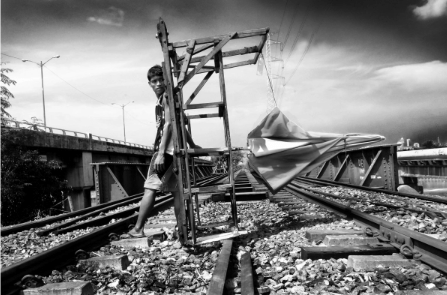 This is how an online news describe the famous “trolley” near the PUP Main Campus: “Trolley is a ride costs ten pesos, much cheaper than public utility vehicles like buses and uv’s. It is made up of bulky piece or length of a cut or fallen tree. It is a bit dangerous, these makeshift wooden carts take Filipinos to work or school without the hassle of traffic and at a cheaper price.”
(DISCLAIMER: We didn’t make this blog because we just wanna become famous for saying flowery words about trolley. We really had to experience the feeling of the commuter while riding it as well as the trolley boy who is responsibe for this kind of living and his passengers’ safety.) 
As we passed along the way of venturesome railway, we noticed the lifestyle of Filipinos especially trolley boys living nearby, we assumed that they are suffering because of homelessness, hunger, and lack of money.
So as we continued to ride unto this trolley, we took the opportunity to ask questions to one of those trolley boys who drive this kind of vehicle.
We met and ride at Mr. Nomer Agaton’s trolley, 30 years old, with 3 children living with her wife alongside PNR Sta. Mesa station. We interviewed him while driving and here are the things he mentioned that he and his family is facing through out being poor. He revealed: 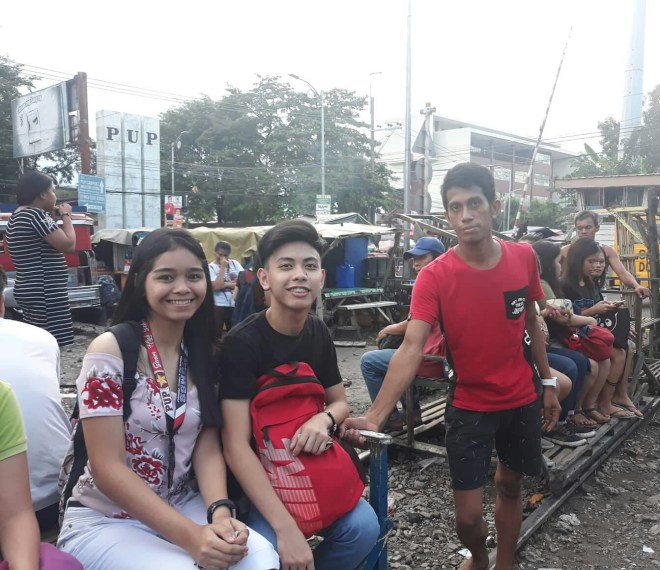
“Hindi to madali, delikado ang aming hanapbuhay”, he said as he used his feet for the trolley to make it run. He usually earns 230-300 pesos per day and that is very insufficient for their daily needs but he can do nothing about but just to accept it because they were undergraduate of high school.
“‘Di na kami umulit ng asawa ko mag-apply sa mga trabahong may mas malaking kita kasi ang daming kailangan katulad ng birth certificate eh pang-upa nga sa bahay eh wala kami.”
With poverty plaguing the country and employment opportunities being scarce, many Filipinos are unable to afford housing, which puts them in danger of turning to the streets for accommodation.
“Minsan ‘yung asawa ko’t dalawa kong anak ang naghahanap-buhay kapag may sakit ako para lang makaraos nang hindi kumalam ang sikmura.” I can’t imagine a woman pushing a trolley with full force together with her children risking their lives just to earn money without thinking of what might happen to them and their future just to survive the present. This is because, parents often can’t make enough money to support their families; children then have to be taken out of school to work in harsh and hazardous conditions. Technically, child labor.
“Tatlo aking anak. Dapat apat kaso namatay ‘yung bunso dahil puro bulate daw ‘yung tiyan kaya lumobo sabi ng doktor at may klorera (cholera).” Hunger is one of the extreme effects of poverty in the Philippines. With little money to buy food, Filipinos are having to survive on very limited food. And without having a stable job, loss of income will prevail. There is a low demand for food supplies in less developed areas that are home to low-income residents.
According to Merriam-Webster Dictionary, poverty is the state of being poor who lacks a usual or socially acceptable amount of money or material possessions. Does Merriam referring to Philippines? Does mostly of Filipinos lacks in money and material possessions? Why does almost 75% of Filipinos are still fighting against poverty but none of them has ever succeeded? Why does poverty became a mainstream issue and most likely an illness without a cure?
Poverty and inequality in the Philippines remains a challenge. In the past four decades, the proportion of households living below the official poverty line has declined slowly and unevenly. Furthermore, poverty has proven to be one of the most significant challenges facing this country and its citizens. Filipinos are having a hard time surviving in such difficult conditions, and more and more are falling into extreme poverty.
Economic growth has gone through boom and bust cycles, and recent episodes of moderate economic expansion have had limited impact on the poor. Great inequality across income brackets, regions, and sectors, as well as unmanaged population growth, are considered some of the key factors constraining poverty reduction efforts.
We are all saddened by the reality that Philippines is one of the slowest country to eradicate poverty proved by being one of the Top 50 poorest country in the world. Nevertheless, it is not too late. Let’s help each other and help the humanity to improve each individual for us to achieve rapid economic growth to lift up our standard of living.
We should practice creating opportunities for children means also ensuring that the poor attend school and that the schools they attend foster learning. Also, unlocking Filipinos’ potential is critical in bringing down poverty in the entire country.
Let us also encourage the government, NGOs, and public sectors to create more and better jobs, to offer opportunity for the poor to lift themselves out of poverty. As well as, imparting to ourselves the importance of maternal health also to give more attention in health interventions on the “first 1000 days” of life.
Again, IT. IS. NOT. TOO. LATE.
With solid economic fundamentals, the Philippines can overcome poverty. It is important to break the cycle of inequitable investment in human capital, making the pattern of growth more inclusive and creating opportunities for more and better jobs.
We can achieve our goals.
We can conquer our weaknesses.
We can save our country.
We can give life to the hopeless.
We can eradicate hunger, homelessness, and poverty.
Help one another. Give one another. Love unconditionally one another.
By Cave Kristan Acuña and Irish Joy Flores





 Marami na akong kapatid sa nanay at tatay ko, pero mas marami pa yung mga kapatid ko sa labas, hindi man sa dugo pero sa puso. Maging ang iba rin nama’y may kapatid sa labas, sila yung mga tunay na kaibigan.
 Humanist Talk